How to Build a Preventive Maintenance Program & Checklists
Founder & Editor, Template Registry
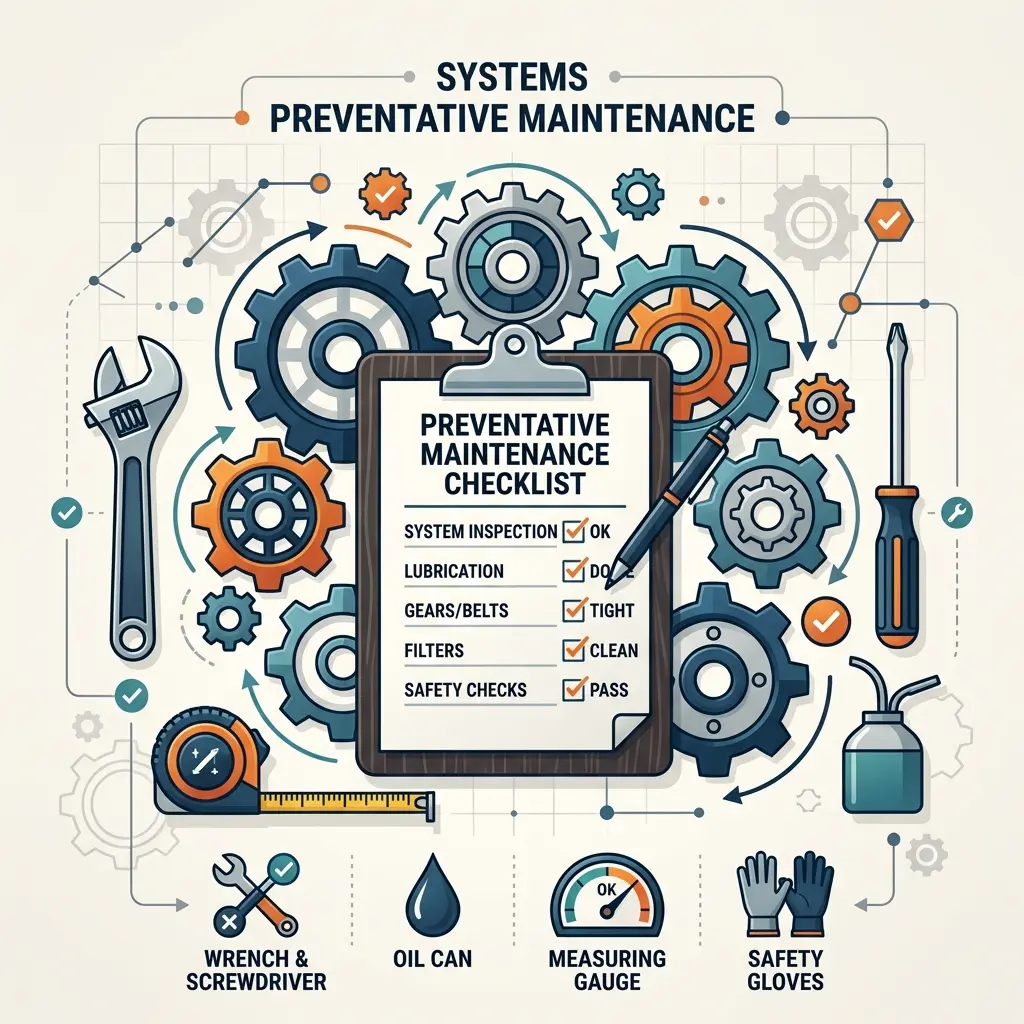
Stop waiting for machines to break before you decide to fix them. Reactive maintenance is a fast track to burned-out teams, skyrocketing spare-parts costs, and catastrophic downtime. A world-class preventive maintenance (PM) program shifts the focus from fire-fighting to precision. It forces the equipment to work for you, rather than the other way around.
Key Takeaways: Preventive Maintenance Program Checklists
| Question | Answer |
|---|---|
| What defines a PM checklist? | A standardized, step-by-step procedure used to inspect, clean, or calibrate equipment at recurring intervals. |
| Why use them? | They eliminate human error, ensure compliance with safety standards, and extend asset life. |
| What do they include? | Safety requirements, specific tools, clear pass/fail criteria, and escalation protocols. |
| How often should they run? | Based on equipment criticality, manufacturer specifications, and operational duty cycles. |
| How to start? | Audit your assets, prioritize by risk, write the SOP, and iterate based on technician feedback. |
Understanding the Framework: Preventive Maintenance Definitions
Before building your system, align your vocabulary with industry standards. According to Department of Energy maintenance guidelines, maintenance is not a single act; it is a lifecycle.
- Preventive Maintenance (PM): Actions performed at scheduled intervals to prevent failure or degradation. This adheres to ISO 14224 standards regarding data collection and reliability.
- Standard Operating Procedure (SOP): A set of written instructions that document a routine or repetitive activity.
- Criticality Analysis: The process of ranking assets based on the impact their failure would have on operations, safety, and the environment.
- Mean Time Between Failures (MTBF): A key reliability metric indicating the predicted elapsed time between inherent failures of a mechanical or electronic system.
Phase 1: Asset Auditing and Prioritization
You cannot maintain what you haven’t tracked. Start by building a comprehensive asset register. Many organizations fail here because they try to put every single device on a PM schedule. That is a mistake.
If you treat a low-cost, non-critical desk fan with the same rigor as a mission-critical CNC machine, you will waste thousands of hours. Categorize your equipment into three tiers:
- Tier 1 (Critical): Failure stops production or creates a safety hazard.
- Tier 2 (Essential): Failure reduces efficiency or quality but allows temporary operation.
- Tier 3 (Non-Essential): Failure has minimal impact on the facility.
Focus 80% of your initial design effort on Tier 1 assets. For areas where cleanliness is tied to machine longevity, implementing a 5s laboratory audit protocol is essential to ensure that your maintenance environment remains free of contaminants that cause premature component wear.
Phase 2: Writing the SOP (Standard Operating Procedure)
An SOP is useless if it lives in a binder on a shelf. It must exist where the technician works. A high-quality SOP functions as a roadmap, not a novel.
Start with the objective. Why are we doing this? If the answer is "because management said so," rewrite it. The objective should state, "To ensure the hydraulic pressure remains within 1500–1800 PSI to prevent seal blowout."
Structure your SOP as follows:
- Safety Requirements: Mention PPE (Gloves, eye protection, lockout/tagout procedures).
- Tools Required: List the specific hex keys, torque wrenches, or diagnostic software required.
- Step-by-Step Procedure: Use imperative verbs. Avoid vague language like "check the belt." Use "Inspect the drive belt for cracks deeper than 2mm and ensure tension is set to 45 lbs."
- Acceptance Criteria: Provide a clear "Yes/No" threshold. If the part doesn't meet the criteria, the SOP must explain exactly what to do next.
Phase 3: Designing Effective Preventive Maintenance Program Checklists
The checklist is the final gatekeeper of your maintenance system. It transforms complex technical manuals into a repeatable, audit-ready format. To design a functional checklist, move away from long-form paragraphs and toward binary inputs.
The "Do Not Do" List for Checklists:
- Avoid subjective questions like "Is it clean?" or "Does it sound okay?"
- Avoid using non-technical personnel to write checklists for technical tasks.
- Avoid printing static PDFs that can’t track historical data trends.
The "Do" List for Checklists:
- Use Visual Cues: Include photos of what a "good" versus a "bad" component looks like.
- Mandatory Data Entry: Require technicians to record actual readings (e.g., "Actual Temperature: 142°F") rather than just checking a "Pass" box. This creates a data trail that helps you predict future failures.
- Logical Flow: Arrange the steps in the order the technician moves around the machine. Don’t make them walk from the front to the back and then back to the front.
Phase 4: Implementation and the Feedback Loop
Once your checklists are ready, do not launch them across the entire facility. Pilot them.
Pick one technician and one machine. Have the technician perform the task while you observe. Are there parts of the SOP that are confusing? Do they feel like they are wasting time during certain steps? This is the most important part of the design process.
If a technician has to work around your checklist to get the job done, the checklist is the problem, not the technician. Incorporate their feedback. Make the system easier to follow. When the technicians see that the system is designed to help them rather than track their every move, buy-in happens naturally.
Integrating Compliance and Safety
Safety is not an add-on; it is the foundation. Every PM checklist should start with a Lockout/Tagout (LOTO) verification. According to OSHA standards, failing to isolate energy sources is a leading cause of workplace accidents.
Your checklists should explicitly ask the technician to confirm that the energy source is disconnected and the residual energy (like hydraulic pressure or compressed air) has been bled off. If your maintenance software allows it, require the technician to upload a photo of the locked-out switch before they can even access the rest of the checklist. This prevents shortcuts that seem harmless until they aren't.
Scaling and Data Analysis
After three months of using your new PM program, you will have a dataset. Start analyzing it.
- Are technicians constantly replacing a part that never shows signs of wear? Maybe you can increase the interval from monthly to quarterly.
- Are technicians finding issues that weren't on your checklist? Update the SOP.
- Is one machine failing despite regular PMs? Your PM might be too light. You might need a deep-dive predictive analysis (like vibration monitoring or thermography) rather than just a visual inspection.
Use this data to shift from preventive maintenance (time-based) to predictive maintenance (condition-based). This is where the real operational efficiency gains happen. When you stop touching perfectly healthy machines and only service those that show early signs of degradation, you slash your labor costs and parts budget simultaneously.
The Human Element: Training and Culture
A perfectly designed system will fail if the culture is toxic. If maintenance is viewed as "getting in the way of production," the team will rush through checklists just to get the machine back online.
Management needs to support the maintenance team when they stop a line because of a critical finding. If a technician flags a failing bearing, they should be rewarded, not penalized for the downtime that ensues. The PM program is your early warning system. Treat every finding as a victory—you’ve just prevented an unplanned stoppage that would have been three times as expensive.
Putting This into Practice
Designing a preventive maintenance program is an iterative process. Start small. Pick your most critical, most troublesome asset and apply the logic outlined above. Draft the SOP. Build the checklist. Perform the pilot. Gather the data.
Once you have one machine optimized, move to the next. Do not try to convert your entire facility overnight; you will lose control of the quality.
Consistency is the bedrock of operational excellence. By standardizing your maintenance tasks into clear, actionable checklists, you remove the guesswork. You turn maintenance from a reactive, chaotic chore into a predictable, high-performing system.
The goal isn't just to keep the machines running. The goal is to build an environment where your team knows exactly what to do, how to do it safely, and when to speak up before a failure occurs. Start with your checklists, stay disciplined with your data, and the uptime will follow.

About the Author
Julian Vance is a systems architect and process engineering expert specialized in developing elite Standard Operating Procedures (SOPs) and fail-safe checklists.