The Complete Guide to Low Voltage (LV) Switchgear Preventive Maintenance
Julian Vance
Chief Architect & Systems Engineer
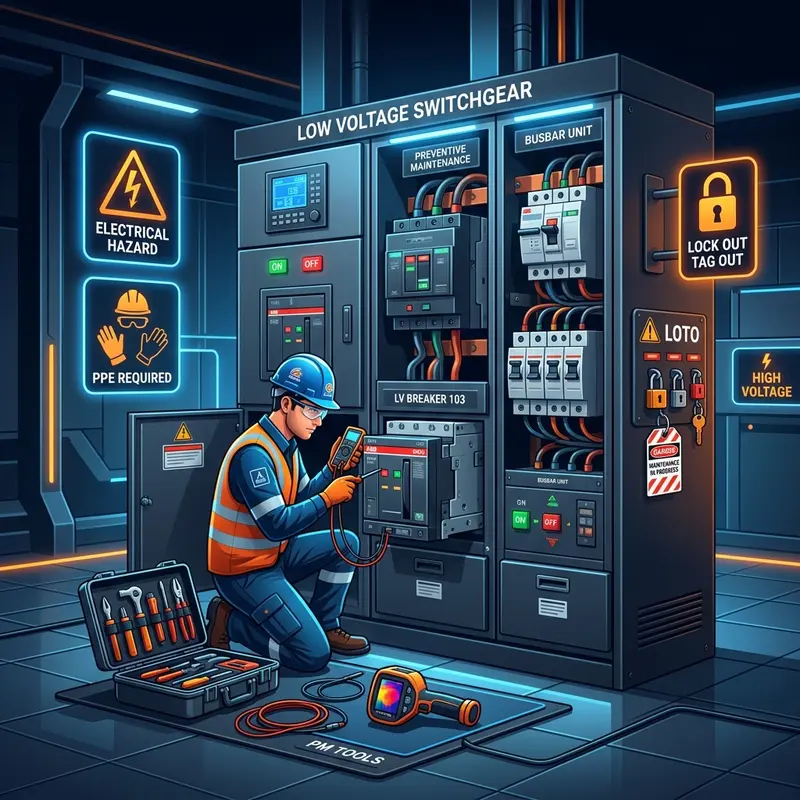
Reliable electrical distribution is the backbone of any commercial facility or manufacturing plant. At the heart of this system lies the Low Voltage (LV) switchgear. Because these systems run continuously in the background, they are frequently overlooked until a critical failure occurs. An unexpected switchgear outage can lead to costly operational downtime, expensive repair bills, and significant safety hazards, including arc flash incidents. Establishing a rigorous preventive maintenance program is the only way to safeguard your facility.
Key Maintenance Phases & Procedures
To ensure your switchgear remains safe and reliable, maintenance should be divided into structured phases. Use this summary table to track your maintenance cycles.
| Phase | Core Focus | Critical Action |
|---|---|---|
| Safety & Isolation | De-energize and ground | Execute strict Lockout/Tagout (LOTO) and verify zero energy. |
| Visual & Cleaning | Dust and corrosion removal | Vacuum internal cubicles; check ventilation flow. |
| Mechanical Maintenance | Lubrication & mechanism check | Test circuit breaker racking mechanisms and contact wear. |
| Electrical Testing | Insulation and contact test | Perform Megger insulation resistance and contact resistance (Ductor) tests. |
Step-by-Step Maintenance Guide
1. Safety First: The Isolation Protocol
Before touching any internal component, you must guarantee a zero energy state.
- Coordinate with the utility provider and facility team to schedule a planned shutdown.
- Apply Lockout/Tagout (LOTO) padlocks and tags to all upstream isolation breakers.
- Verify the absence of voltage on all phases and neutral connections using a CAT IV-rated, calibrated voltmeter.
- Install safety ground leads on the main busbars to prevent accidental re-energization.
2. Physical Inspection & Environmental Control
Dust, moisture, and pests are the primary enemies of electrical insulation.
- Vacuum clean the entire enclosure. Avoid using compressed air, which can push metal shavings or conductive dust deeper into delicate relay components.
- Inspect for water stains or rust on the enclosure, which indicates external water leaks.
- Verify that space heaters inside the cabinet are operational; these heaters prevent condensation, which causes tracking and electrical shorting.
3. Circuit Breaker Maintenance
Circuit breakers must trip rapidly and reliably during an overload or short circuit.
- Rack out the air circuit breakers (ACBs) or molded case circuit breakers (MCCBs).
- Clean and lightly apply manufacturer-recommended grease to racking mechanisms. Avoid over-lubricating, which attracts conductive dust.
- Inspect the main contacts for pitting, carbon build-up, or signs of overheating.
4. Busbar Connections & Torque Testing
Loose connections are the single largest source of electrical fires in switchgear systems.
- Conduct an infrared thermal scan of all bolted connections prior to shutdown (while under load) to isolate hotspots.
- Use a calibrated torque wrench to verify connection tightness according to the manufacturer’s torque specs.
- Check support insulators for tracking marks or micro-fractures.
📥 Free Template Download
Skip the paperwork. Download our fully compliant, print-ready LV Switchgear Preventive Maintenance SOP & Checklist.
- Includes: Detailed checklists, NFPA 70E safety protocols, and testing logs.
- Format: Ready for PDF export.
Technical Tests You Must Perform
- Insulation Resistance (Megger) Test: Measure phase-to-phase and phase-to-ground resistance. Low values indicate moisture intrusion or deteriorated insulation.
- Contact Resistance Test (Ductor Test): Measures the micro-ohm resistance across circuit breaker contacts. High resistance leads to overheating.
- Protection Relay Functional Test: Inject secondary current to verify that the overcurrent and short-circuit relays trip the circuit breaker within the designated milliseconds.
Common Maintenance Pitfalls
- Pitfall - Rushing LOTO Checks: Assuming a breaker is open without testing with a meter is a fatal mistake. Always "Test Before Touch."
- Pitfall - Improper Lubrication: Using generic grease can degrade insulation materials and bind mechanical linkages. Always use the specified grease recommended by the manufacturer.
- Pitfall - Skipping Grounding: Even after isolation, cables can store capacitive charges. Always ground the circuits before proceeding with maintenance work.
About the Author
Julian Vance is a systems architect and process engineering expert specialized in developing elite Standard Operating Procedures (SOPs) and fail-safe checklists.