How to Write an SOP: A Guide to Operational Efficiency
Founder & Editor, Template Registry
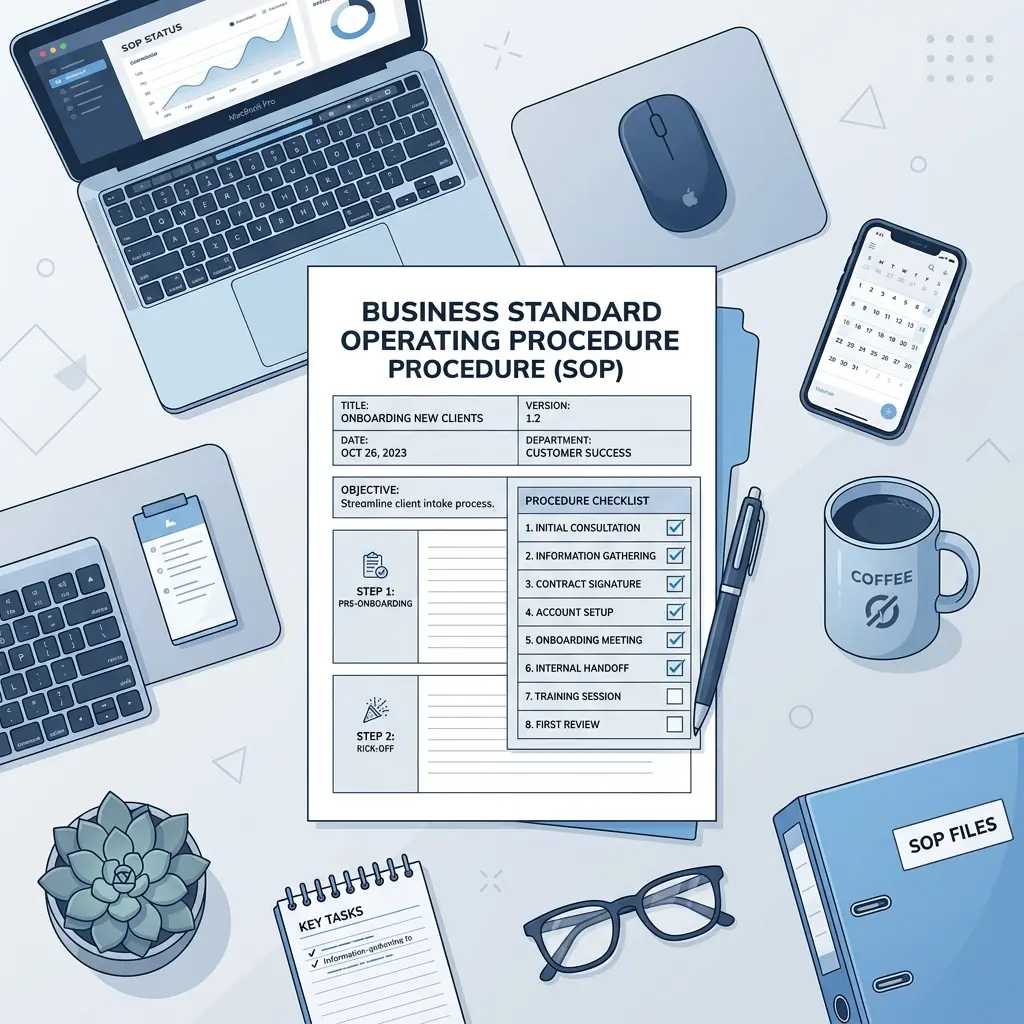
Chaos is the silent killer of growth. If your team spends more time guessing how a process works than actually executing it, your operations are bleeding efficiency. Most companies struggle because they view documentation as a chore—a dusty binder destined for a shelf. Effective operations teams treat SOPs as the living, breathing architecture of their business. If you want to scale, you need a blueprint.
The Quick Guide: How to Write an SOP
If you need the "what" and "how" immediately, here is your breakdown for rapid implementation.
| Question | Answer |
|---|---|
| What is an SOP? | A step-by-step set of instructions to achieve consistent outcomes for a specific task. |
| Who writes them? | The subject matter expert (SME) who performs the task daily, not just management. |
| What is the goal? | Reducing variance, ensuring quality, and providing a single source of truth. |
| How do I start? | Map the current process, identify bottlenecks, and document the "happy path" first. |
| How do I maintain it? | Schedule bi-annual reviews or trigger updates whenever the process changes. |
Understanding the Mechanics of an SOP
Before we start writing, we need to clarify what we are actually building. In engineering terms, a Standard Operating Procedure is a control document. According to ISO 9001 standards, documentation is necessary to provide evidence of process control.
An SOP is not a suggestion. It is a technical directive. It defines the "who, what, where, when, and why" of a task. When you standardize, you remove the guesswork. You turn an art—which depends on the individual performer—into a science, which depends on the system.
Defining Key Terms in Operations
To communicate effectively across your organization, use consistent terminology.
- Standard Operating Procedure (SOP): A set of written instructions that document a routine or repetitive activity followed by an organization.
- Work Instruction (WI): A document that details the specific steps to perform a task. While an SOP describes the "what" and "who," a Work Instruction describes exactly "how" to manipulate the tools or software.
- Process Map: A visual representation of a workflow, usually using flowcharts to show decision points and dependencies.
- Control Point: A specific step in a process where a measurement or check must occur to ensure the output remains within quality tolerances.
Why Most SOPs Fail
Most documentation efforts fail because they are written by people who do not actually perform the work. They are often too long, too complex, or stuck in a PDF format that nobody can find.
If your SOP is fifty pages long, nobody will read it. Your team will ignore it, work around it, or build their own "shadow processes." Keep it lean. If a step doesn't directly contribute to the quality of the output, delete it. If the process is complex, break it into smaller sub-tasks.
Phase 1: Planning and Scoping
Before you open a blank document, identify your target. What is the specific pain point? Is it a high turnover rate during hiring? Then you need a formal candidate onboarding checklist to ensure every new hire gets the same experience. Is it a safety issue in your facility? You might need a 5s laboratory audit protocol to maintain rigorous standards.
Action Steps:
- Identify the Process: Pick one specific workflow. Do not try to document the entire company at once.
- Interview the SME: Sit down with the person who knows this task inside and out. Do not write this in isolation.
- Draft the Objective: Clearly state what success looks like. If you can’t define what a "good" output is, you can’t define the procedure to get there.
Phase 2: Structuring Your SOP
A professional SOP follows a logical hierarchy. Use this structure to maintain consistency across your department:
1. Title and Metadata
Include the document ID, version number, author, and approval date. If you don't track versions, you lose control.
2. Scope and Purpose
Why does this procedure exist? Who should use it? Define the boundaries so no one tries to apply a manufacturing SOP to a marketing task.
3. Roles and Responsibilities
Use a RACI matrix (Responsible, Accountable, Consulted, Informed) if the task involves multiple stakeholders. Ambiguity is the enemy of execution.
4. The "Happy Path" (Steps)
Use imperative verbs. "Click," "Verify," "Submit," "Save." Avoid passive phrasing like "The button should be clicked." Instead, write "Click the 'Submit' button."
5. Troubleshooting and Exceptions
What happens when things go wrong? If the system crashes at step 4, what is the recovery protocol? Documenting the exceptions is what separates a novice SOP from an expert one.
Phase 3: Drafting for Clarity
When you sit down to write, focus on the user, not the process. Your audience is likely rushed, tired, or learning the task for the first time.
Use Visuals Strategically: A screenshot with a red box is worth a paragraph of text. If you are describing software, show the UI. If you are describing a physical task, use annotated photos. Video clips are even better—use tools like Loom or Scribe to capture the action in real-time.
Keep it Modular: If a process involves using three different software tools, create three separate, smaller SOPs and link them. This makes maintenance a breeze. When one tool updates its interface, you only have to update the sub-module, not the entire master document.
Phase 4: Review, Validate, and Iterate
Once the draft is done, do not publish it yet. This is where most organizations miss the mark.
The "Can you do it?" Test: Take someone who has never performed the task, hand them the SOP, and watch them do it. Do not say a word. If they get stuck, your SOP is broken. If they reach a step where they have to ask, "Wait, what does this mean?", you need to rewrite that section.
Validation is a requirement: If you operate in a regulated industry, validation is a legal requirement. You need documented proof that the process you wrote actually produces the intended result every single time.
Maintaining Your SOP Library
A static SOP is a dying SOP. As your technology, team, and market evolve, your procedures must shift.
Establish a Review Cadence: Don't wait for things to break. Schedule a review every six or twelve months. Assign an "Owner" to every document. If a document has no owner, it will become obsolete within a year.
Create a Feedback Loop: Your team should have an easy way to report issues with the SOP. If someone finds a more efficient way to do the work, the SOP should reflect that improvement. Make it a point of company culture to "document the improvement."
Putting This into Practice
Building an SOP culture isn't about control; it's about freedom. When you standardize the basics, you give your team the mental bandwidth to focus on innovation. You stop fixing mistakes and start shipping value.
Start small. Take one process that frustrates your team and apply the steps above. Map the flow, write the steps, test it with a user, and publish it in a central, searchable knowledge base. Once your team sees the reduction in friction, they will start asking for more. They will realize that clear systems are the best teammates they have.
Don't look for the perfect process before you start. The "perfect" process is a myth. Start with the process you have, document it, and refine it through usage. Your future self—and your entire operations team—will thank you for the clarity.

About the Author
Julian Vance is a systems architect and process engineering expert specialized in developing elite Standard Operating Procedures (SOPs) and fail-safe checklists.